Why Do Koreans Take Off Their Shoes Indoors?
If you’ve watched enough K-dramas, you know the scene. A character storms through the front door, or sneaks in after a late night, or arrives with a nervous bouquet to meet the in-laws. Then comes the tiny, ritual shuffle: kick off the shoes, step up, and carry on with the drama.
It looks like a small detail, but it’s one of the most deeply rooted habits in Korean daily life.
So why do Koreans do it? Grab a snack (shoes off, please), because the answer involves heated floors, muddy roads, and one very good reason to buy nicer socks.
Short on time? Here’s the 30-second version.
(Spoiler: heated floors, good manners, and your socks are about to be judged.)
Now let’s unpack all of that, starting with the star of the show: the floor.
The Short Answer: It’s All About the Floor
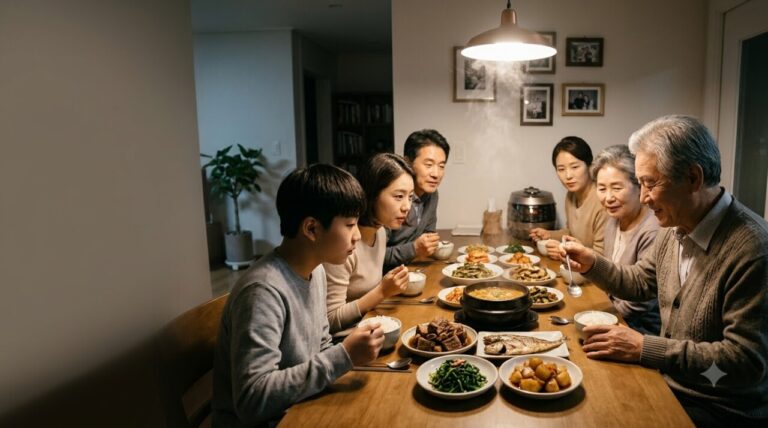
In Korea, the floor isn’t just a floor. Traditionally it’s your sofa, your dining table, your bed, and your nap spot, all in one. Once you see the floor as living space rather than something you merely walk on, wearing outdoor shoes on it starts to feel as strange as wearing them on your bed.
And the floor in question is usually heated.
Meet Ondol: The Heated Floor That Shaped a Nation
The key to understanding this habit is ondol (온돌), a traditional underfloor heating system. In a classic Korean house, the smoke and heat from the kitchen hearth were channeled through flues beneath a stone floor, which was covered with layers of clay and oiled paper. The whole room warmed from below.
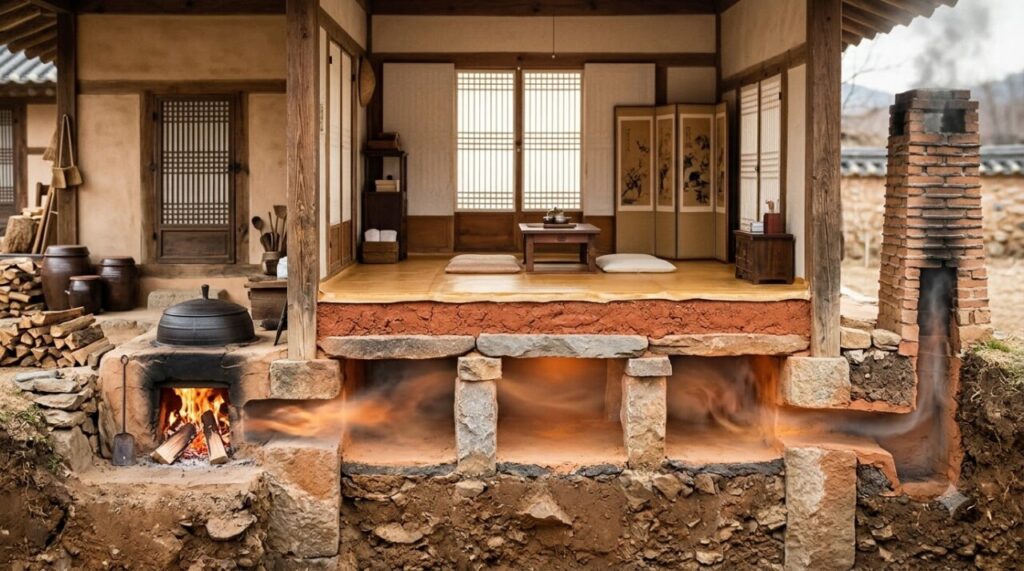
Archaeological evidence suggests that heating systems like this go back a very long way. Ondol-like structures have been found in sites associated with the ancient northern kingdoms of the Korean peninsula, including Goguryeo. Over many centuries the system spread, and by the later Joseon period, ondol had become the standard way to heat a home across the country.
Here’s why that matters. When your floor is the warmest spot in the house, you naturally sit, eat, and sleep on it. Koreans traditionally ate at low tables, slept on thin padded mattresses(yo) laid out on the floor, and folded them away in the morning. Nobody wants to lie on a floor that’s been stomped on by shoes that were just on a muddy road.
Ondol also explains why Korean homes didn’t need much furniture. The floor did the heavy lifting, and keeping it clean was the whole point.
Other Reasons the Habit Stuck
Ondol is the big one, but historians and cultural commentators point to several other factors that reinforced it.
1. Climate and mud. Korea has four distinct seasons, including a rainy summer monsoon and cold, snowy winters. For most of history, roads were unpaved. Shoes (traditionally made of straw or leather) picked up a lot of mud, and tracking that into a room where you also sleep was a bad idea. This explanation is widely cited, though it’s a practical inference rather than a documented “rule.”
2. A clear line between “outside” and “inside.” Traditional Korean houses had a raised wooden porch (maru, 마루) and a flat stone step (daetdol, 댓돌) where shoes were left before entering. Stepping up from the shoe area marked the move from the dirty outside world into the clean inner space. Modern apartments carry on this idea with a small sunken entryway (hyeongwan, 현관) right inside the front door.
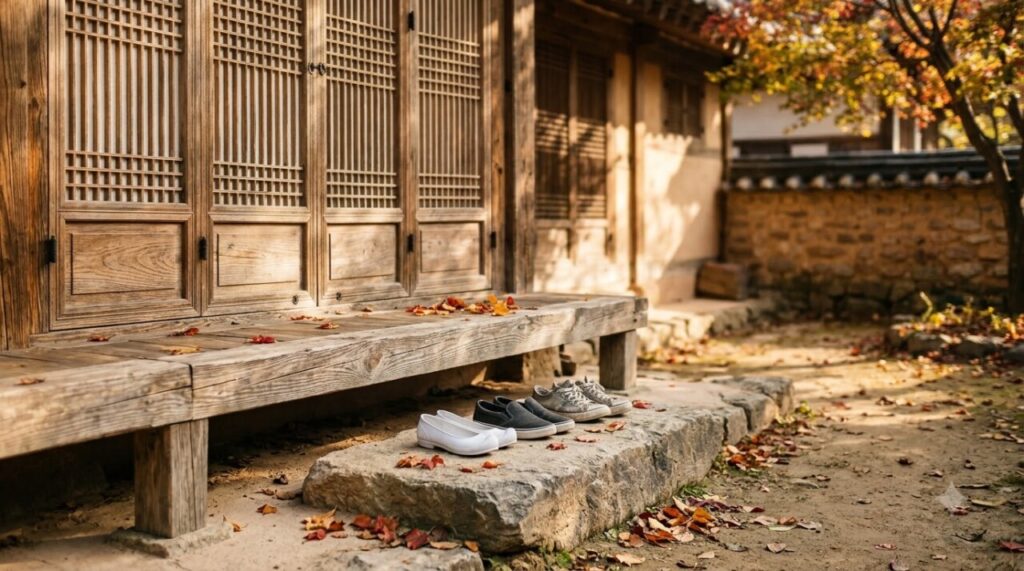
3. Respect. Think of it from the host’s point of view. In a home where the floor is where everyone sits, eats, and sleeps, walking in with outdoor shoes is a bit like climbing onto someone’s bed with them. Taking your shoes off is a small way of saying, “I respect your space.” Koreans notice this gesture, especially in front of elders, where good manners count double. Bonus points if you line your shoes up neatly with the toes facing the door.
4. Hygiene. And then there’s plain old cleanliness. Think about where your shoes have been today: sidewalks, public restrooms, the subway station, that suspicious puddle. Now imagine all of that on the floor where you sit, where a baby crawls, and where you sleep at night. In a floor-based home, the street stays at the door. It’s just common sense.
Is Korea the Only Country That Does This? Not at All.
Not even close. Taking shoes off at home is common in much of East Asia, parts of the Middle East, Northern Europe, and Canada. But the reasons and details differ.
Japan is the closest cousin. Japanese homes have a genkan, a sunken entryway where you remove your shoes before stepping up onto the main floor. Like Korea, traditional Japan had a floor-based lifestyle, with tatami mats and futon bedding. The big differences are in the details. Japanese homes traditionally relied on other heating methods (like charcoal braziers and later the kotatsu, a heated table) rather than heating the floor itself. Japan is also known for a strict slipper system: slippers for the hallway, a separate pair for the toilet, and no slippers at all on tatami. In many Korean homes, people simply go around in socks or barefoot because the floor is warm, and slippers are less of a rule.
Turkey, Iran, and parts of Central Asia also remove shoes indoors, and the logic is similar: carpets and floor seating are central to the home, and keeping them clean matters. In many of these places, the connection to religious cleanliness customs is also strong, especially around spaces where people pray. Korea’s habit, by contrast, is mainly rooted in housing structure and daily practicality rather than religious practice.
Nordic countries such as Finland, Sweden, and Norway are a fun comparison. Their reason is more weather-driven: snow, slush, and salt on the roads mean boots stay at the door. But their floors are usually not used for sitting and sleeping in the Korean way, so the habit is closer to “keep the house tidy” than “the floor is where we live.”
So the shared theme is a clean indoor floor, but Korea’s special ingredient is the heated floor lifestyle. That’s what makes it feel less like a polite custom and more like common sense.
Wait, Are There Exceptions? Yes, Several.
Before you start worrying about where to take your shoes off in Korea, here’s the practical guide.
You usually keep shoes ON at:
- Most restaurants and cafés with tables and chairs
- Offices (though some people switch into indoor slippers at their desk)
- Hospitals, clinics, and pharmacies
- Department stores, shops, and public buildings
- Western-style venues like bars, theaters, and hotels
You usually take shoes OFF at:
- Someone’s home (always)
- Traditional Korean restaurants with floor seating, where there’s a shoe shelf or a row of shoes at the entrance
- Hanok guesthouses and traditional tea houses
- Some small clinics, fitness studios, and wellness spaces
- Korean saunas (jjimjilbang, 찜질방)
A helpful rule of thumb: if you see a raised floor, a row of shoes, or a shoe rack, that’s your signal.
If you’re unsure, just look at what everyone else is doing or ask politely. People will be glad you asked.
A pro tip, with love: wear socks without holes. This sounds like a joke, but it really is a thing.
You never know when a restaurant or a friend’s apartment will ask you to take your shoes off, and the hole in your sock will be the star of the evening.
Generational Differences: How the Habit Is Changing
The core habit hasn’t gone anywhere. Almost every Korean home still has a shoe-free interior, even brand-new studio apartments. But how people live on that floor has changed a lot.
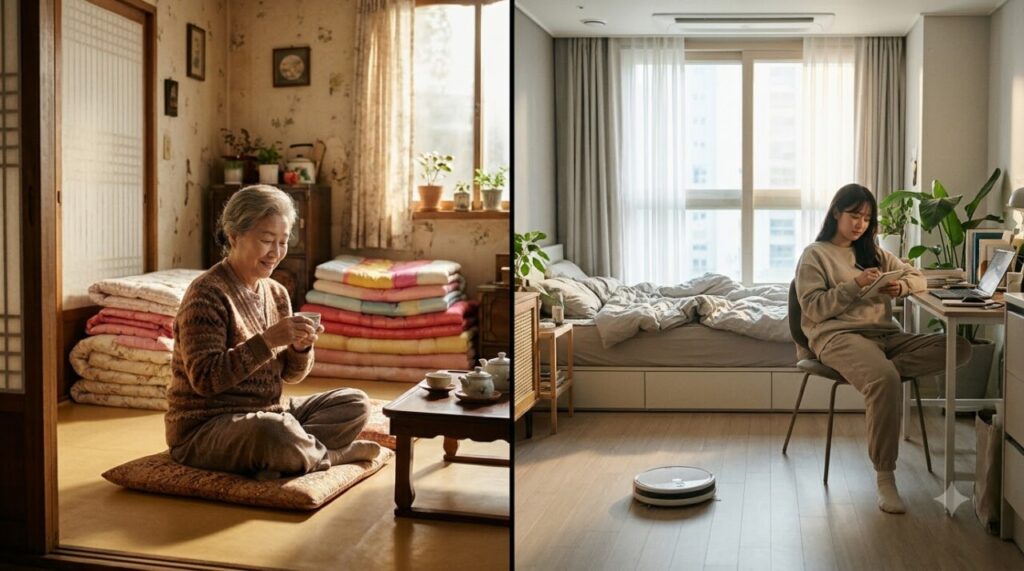
Older generations grew up with ondol floors, floor cushions, and sleeping on mats. For many of them, sitting on the floor is simply the natural, comfortable way to be, and the idea of wearing shoes indoors is almost unthinkable.
Younger Koreans are much more likely to live with beds, sofas, desks, and dining tables. The floor still gets walked on barefoot, but it’s no longer the center of everything. Many younger people also wear house slippers or “room shoes,” especially in colder months or in homes with less efficient heating.
The heated floor itself hasn’t gone anywhere, though. In modern apartments, ondol is now typically hot-water pipes under the floor rather than traditional wood-burning flues, so that daily comfort is still there.
Still, even as lifestyles become more Western, the shoes-off rule is surprisingly stable. It’s less about tradition for tradition’s sake and more that it simply works, because the home is a clean, warm, shared space.
So, What Should You Do When You Visit Korea?
The next time someone invites you to their place, here’s your cheat sheet:
- Remove your shoes at the entrance, even if the host says “it’s okay.”
- Place them neatly, toes toward the door if you can.
- Accept the slippers if they’re offered, and don’t be shy about asking.
- Bring decent socks. Seriously.
Do this and you’ll look like a seasoned insider. Your host will probably smile and offer you something to eat, because that’s how Korean hospitality works.
Final Thoughts
Taking off shoes in Korea isn’t just politeness or a quirky rule. It’s the result of centuries of living close to the floor, warmed from below by one of the cleverest heating systems ever invented. The habit survived because it still makes life cozier and cleaner, even as apartments, furniture, and lifestyles have changed.
So the next time you spot a character quietly slipping off their sneakers in your favorite K-drama, you’ll know it’s not just a scene transition. It’s a tiny window into how Korean homes and Korean life fit together.
Sources
- ASHRAE Journal, Jan 2010, “History of Radiant Heating & Cooling Systems, Part 1”: https://www.nxtbook.com/nxtbooks/ashrae/ashraejournal_201001/index.php?startid=44
- “The History and Characteristics of Korean Traditional Ondol studied through Document Analysis” (International Journal of Ondol, 2009): https://scholar.kyobobook.co.kr/article/detail/4010024999811
- KoreaScience: https://koreascience.kr/article/JAKO201820765438882.do
- Korean Cultural Center, “Hanok”: https://hk.korean-culture.org/en/137/korea/37
- The Japan Forum, “Genkan (entrance)”: https://www.tjf.or.jp/deai/contents/teacher/mini_en/html/genkan.html