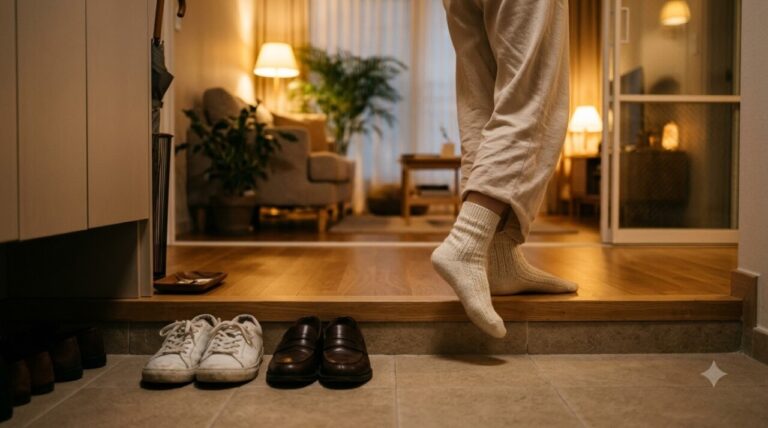
Why Korean dinners start with a very polite game of “After you.” And what it tells you about the Korea behind the screen.
If you’ve ever watched a K-drama family dinner, you’ve seen this moment.
The table is loaded, the stew is bubbling, everyone is starving… and nobody touches a thing.
Then Grandpa lifts his spoon, and the whole table comes back to life like someone pressed “play.”
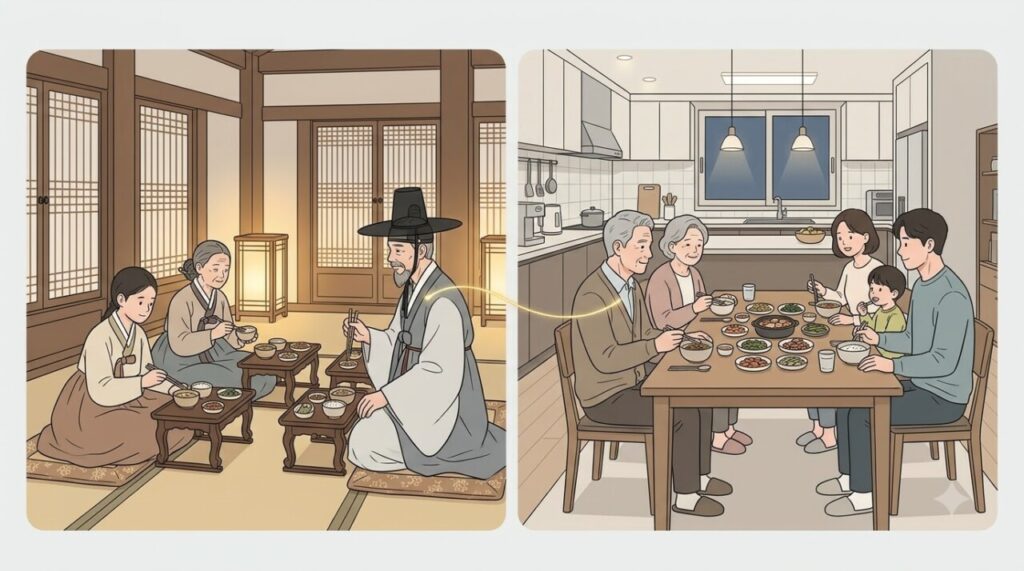
Is this just good TV tension? Nope. It’s a real, everyday rule: no one is allowed to eat until the oldest person at the dinner table has taken their first bite. Think of it as Korea’s built-in “pause” button, and the oldest person holds the remote.
So… how strict is it, really?
Pretty well-known, as these things go. Guides for visitors describe it as the single most important rule of Korean dining etiquette, and they say nearly every other rule flows from “elders eat first.”
Seating, pouring, even how you hold your chopsticks are all downstream from it.
And it doesn’t stop at the first bite. You’re also expected to match your eating speed to the eldest person and wait to finish until they have. Some guides add that it’s polite to wait for the oldest person to leave the table first. So no inhaling your food, and no scrolling through your phone while Grandpa takes his sweet time with the soup. (Believe me, this is a lesson in patience.)
Why does this rule exist? Follow the Confucius
Here’s the backstory. Korean etiquette is largely derived from Korean Confucianism.
Confucianism arrived on the peninsula centuries ago, but it truly took over during the Joseon Dynasty.
It became the primary belief system during Joseon (1392–1910), when the ruling class deliberately replaced state-sponsored Buddhism with Neo-Confucianism as the official ideology of governance, ethics, and daily life.
In other words, for over 500 years, “respect your elders” wasn’t just a nice idea. It was the operating system of society.
Three Confucian ideas matter most here: filial piety (hyo), reverence for elders, and hierarchical order. The dinner table is where these ideas get practiced every single day, three times a day. Nobody has to give a speech about respect. You just wait for the spoon.
The sneaky second reason: Korean meals are shared
Korean meals aren’t served in neat individual portions. Rice, soup, stew and a spread of banchan(sidedish) sit in the middle, and everyone digs in together. When dishes are communal, someone has to signal “okay, we’re starting,” so everyone begins as one group. The elder is that signal.
Researchers who studied Korean and Japanese family dinners in 1989 found that 54% of Korean families ate supper together daily, and didn’t begin eating until all family members gathered or the elders began. (The Japanese figure was 27%.) Note that this is an older study, so take the exact numbers as a snapshot of that time, not today.
The drinking version: “Wait, why is he turning his head?”
The same logic applies when the soju comes out. When drinking with elders, there’s a very specific move: you turn your head slightly away. One cultural guide puts it simply: when drinking, turn your head slightly away from elders. The idea is to show respect by not drinking face-to-face with someone senior.
That’s exactly what my AI friend Min explains in this Short.
Is Korea the only one? Not at all
Here’s where it gets interesting for anyone who loves comparing cultures. Many East Asian countries share a Confucian background, so “respect the elders at the table” shows up in several places, with different flavors.
Japan. Very similar in spirit. It’s a polite custom to wait for the eldest or highest-ranking guest to start eating before the other diners do. That said, this is usually described as a courtesy rather than a strict rule, so how closely it’s followed varies by situation.
Vietnam. Even closer to Korea. One Vietnamese cultural account says that at a Vietnamese dinner you may not take your seat until the elders have, may not start eating until they touch their food, and may not leave the table until they finish. Vietnam also has the mời custom of inviting others to eat before you begin.
China. Seating arrangements matter a lot. The guest of honor usually sits facing the door or farthest from it, and you wait for elders or the host to start eating.
The big picture: Vietnam, China, and South Korea share core values of respecting elders, communal dining, and symbolic chopstick etiquette. What makes Korea stand out is how many of these small gestures stack up at one table: the elder’s spoon, the pace-matching, the head turn.
Is it still like this today?
Mostly yes, with a modern twist. Younger Koreans are loosening up, especially with close friends. One person interviewed about Korean customs in a feature by Vietnam’s VOV5 said that younger Koreans are becoming more casual and often skip some formalities, but that core values like respect for elders and communal eating remain strong in daily life.
So if you’re having chicken with your best friend at 1 a.m., nobody is waiting for the oldest person to start. But at a family dinner or a work dinner? Hold your spoon.
Your cheat sheet for the first Korean dinner
- Let the oldest person start. Wait for the spoon.
- Say “jal meok-ge-sseum-ni-da” (잘 먹겠습니다), “I will eat well,” before eating.
It’s customary once you have the green light to begin. - Match the elder’s pace and don’t leave the table first.
- When drinking with elders, turn your head slightly away.
- If in doubt, do what the people around you do.
(Koreans call this nunchi(눈치), and it’s a superpower.)
So the next time you watch a K-drama dinner scene and wonder why nobody is eating, now you know. They’re not being dramatic. They’re being very respectful.
Sources
- Etiquette in South Korea (Wikipedia): https://en.wikipedia.org/wiki/Etiquette_in_South_Korea
- Food Republic, “The Crucial Etiquette Rule To Know While Dining In South Korea”: https://www.foodrepublic.com/1456676/south-korea-dining-etiquette-rule/
- Seoul Tourism, “Korean Dining Etiquette: Complete Visitor’s Guide for 2026”: https://www.seoultourism.org/korean-dining-etiquette/
- The Science Survey, “Threads of Heritage”: https://thesciencesurvey.com/features/2026/03/16/threads-of-heritage-a-view-of-korean-tradition-in-motion/
- HistoryRise, “The Confucian Roots of Korean Respect for Elders and Authority”: https://historyrise.com/article/the-confucian-roots-of-korean-respect-for-elders-and-authority/
- Journal of the Korean Society of Food Culture (1989), Japan–Korea dietary behavior study: https://www.koreascience.or.kr/article/JAKO198903041505125.page?lang=en
- VOV5, “Knowing table manners, knowing social values of a country”: https://vov5.vov.gov.vn/index.php/culture-rendezvous/knowing-table-manners-knowing-social-values-of-a-country-2232713.vov5
- Customs and etiquette in Japanese dining (Wikipedia): https://en.wikipedia.org/wiki/Customs_and_etiquette_in_Japanese_dining
- Culture Trip, “A Guide to Korean Table Manners”: https://theculturetrip.com/asia/south-korea/articles/a-guide-to-korean-table-manners
- Korean Culture Explained (head-turn tip): https://raum.it.com/?p=388