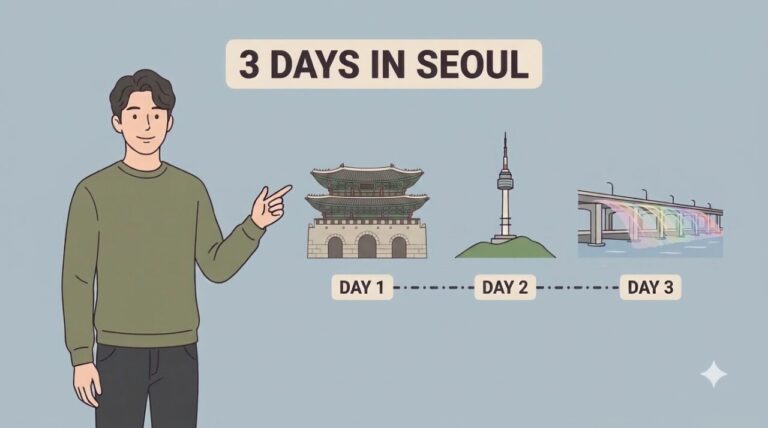
Korean social rules can feel like a lot when you’re landing in Seoul for the first time. This guide covers the five that matter most, and the story behind each one.
Spoiler: nobody expects you to be perfect. But a little know-how will get you from “confused tourist” to “wow, you actually know our culture!” faster than you can say an-nyeong-ha-se-yo, which is “hello” in Korean, and yes, you’ve heard it in every K-drama ever.
So you’ve binged three Korean dramas in one weekend, your K-pop playlist is basically your personality, and you’ve finally booked the flight. Congratulations! You are about to discover that real Korea is even better than the screen version. It is also slightly different, because no drama ever tells you why the lady at the restaurant just handed you a spoon with both hands.
I spent over ten years working at a five-star hotel in Korea, welcoming guests from all over the world. I have watched people do quite a few things “wrong,” and I can tell you the secret: Koreans are incredibly forgiving toward visitors. But when you do get these little things right, you’ll see a genuine smile. Think of this guide as your cheat code.
And because I know you’re the kind of person who asks “but why?” (that’s why we get along), I’ll explain the reason behind each of these Korean social rules.
First, the Big Picture: Why Does Korea Have So Many Social Rules?
Two things shape almost every social habit you’ll notice.
1. Confucian roots. When the Joseon dynasty was founded in 1392, its rulers made neo-Confucianism the guiding ideology of the state, and it stayed that way for roughly 500 years. It taught that society works best when everyone understands their place in relationships: child and parent, student and teacher, younger and older. Even though modern Korea is thoroughly 21st century (hello, 5G on the subway), these ideas are still baked into daily manners and, as you’ll see, into the grammar itself.
2. Living very close together. Seoul is one of the most densely populated big cities in the world, with roughly 15,000 people per square kilometer. When that many people share a small space, unspoken rules about respect and consideration matter a lot.
Keep those two ideas in your pocket. Almost every Korean social rules below connects back to them.
Rule 1: Respect Age (and Yes, People Will Ask How Old You Are)
What you’ll notice: Within five minutes of meeting someone, you may get asked your age. Don’t panic. It is not rude here, and nobody is judging your skincare routine.
Why it happens: This one is actually about grammar. The Korean language has different speech levels, and you literally cannot construct a polite sentence without knowing whether you’re talking to someone older, younger, or the same age. Endings change, and even some words change (“eat” becomes a completely different, more respectful word for an elder). So the age question is less “how old are you?” and more “which version of Korean should I use with you?”
That’s also why you hear oppa, unni, noona, and hyung in your favorite dramas. Each of these words means someone older than you, so you can’t pick the right one without knowing their age. (Fun fact: which one you use depends on your gender and theirs, which is why drama fans get very passionate about the word oppa.)
What to do: Answer cheerfully. If you’re talking to someone older, a slightly softer tone and a smile go a long way.
Rule 2: Use Two Hands (It’s the Politest Move You’ll Ever Make)
What you’ll notice: Cashiers hand you your card with both hands. Your host pours water using two hands. You wonder if you’re being blessed.
Why it happens: In the Confucian-influenced tradition, using both hands shows that you give your full attention and respect to the other person, especially an elder or senior. Giving or receiving something with just one hand, especially from someone older, can look careless. A common variation is to hold your right hand out and gently touch your right forearm or elbow with your left hand. Same message, a bit more relaxed.
What to do: When handing over or receiving money, a business card, or a gift, use both hands. If you’re in a hurry, even a light touch of the other hand counts. Nobody will test you, but people will notice and appreciate it.
Rule 3: At the Table, the Oldest Person Goes First
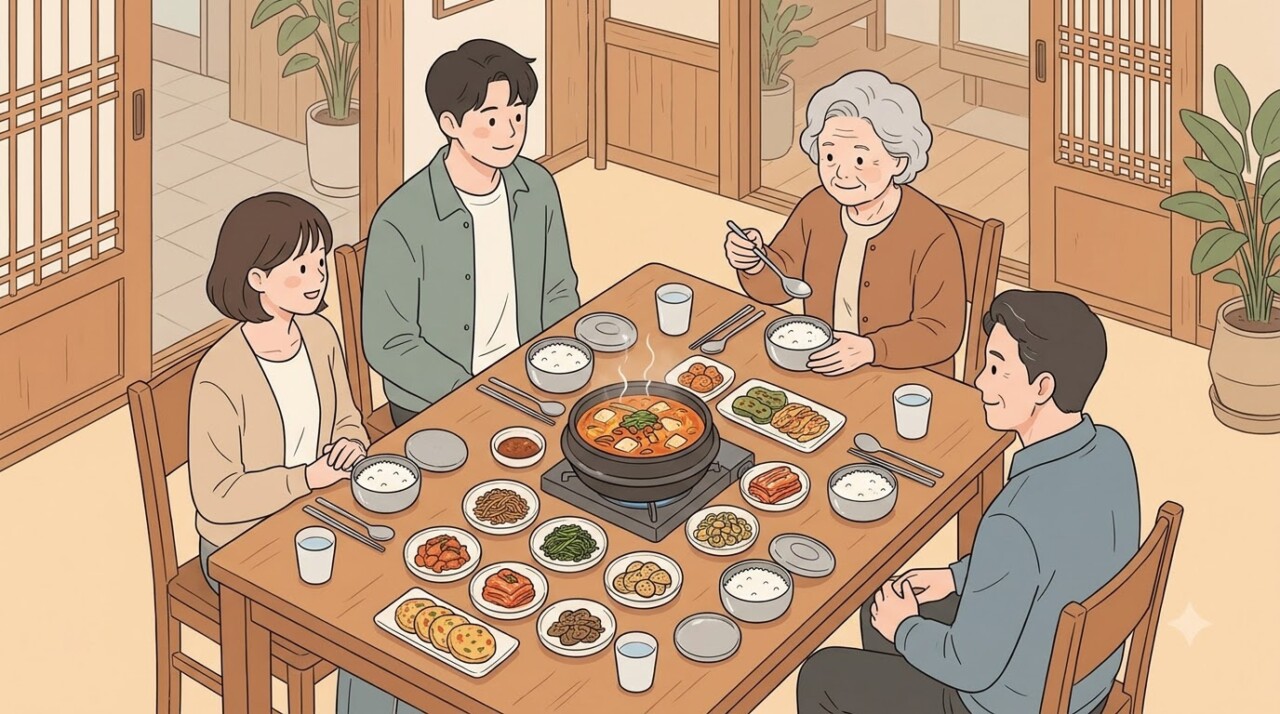
What you’ll notice: Nobody touches their spoon until the eldest person at the table has started.
Also, if you’re drinking with Korean friends, they might turn their heads to the side when sipping in front of elders. Curious how strict the “oldest person goes first” rule really is? We dug into it in a separate post.
Why it happens: Same logic as before: respect for elders shows up in the smallest actions, and this is one of the most visible Korean social rules at the table.
What to do:
- Wait for the eldest person to start before you dig in.
- Don’t stick your chopsticks upright in your bowl of rice. In Korea, this looks like the incense sticks placed at jesa, the ancestral memorial rites. It is a tiny gesture with a big meaning, so lay your chopsticks neatly on the table or rest them on the holder.
- When someone pours you a drink, receive the glass with two hands. When you pour for others, pour for them first, and don’t be surprised when they pour for you too. Pouring each other’s drinks is considered a gesture of closeness, and a glass should rarely be left empty.
Rule 4: Public Spaces Run on Quiet Consideration
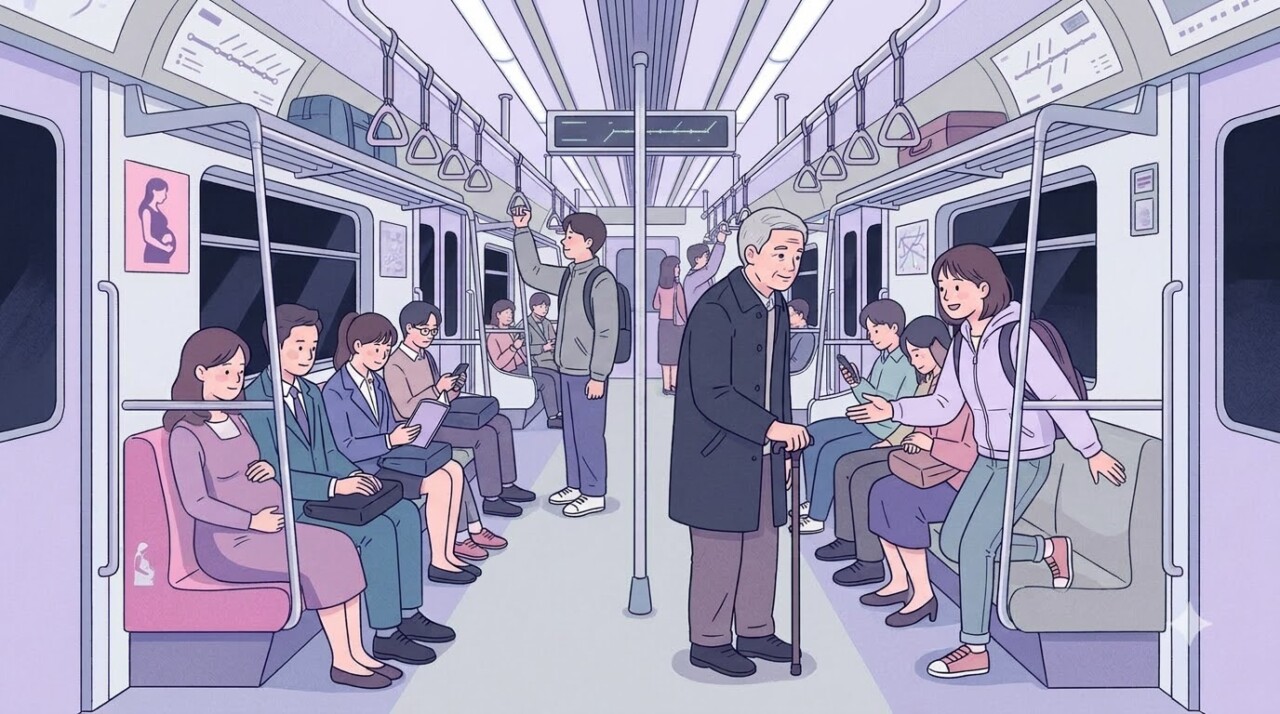
What you’ll notice: Subways are very quiet. People take calls in whispers or text instead. Seats marked for the elderly, pregnant women, and people with disabilities are often left empty, even when the train is packed. And in cafes, people leave a laptop or phone on a table to save their spot while they order, and it’s still there when they come back.
Why it happens: Millions of people share Seoul’s trains, buses, and cafes every day, so a little shared courtesy keeps everything running smoothly. It’s the “consider the group” mindset again, just on a city scale, and it explains many unwritten Korean social rules in public spaces. Respecting elders and people who need help is part of that mindset, which is why priority seats stay open for them. Quiet trains also mean everyone can rest, commute, or catch up on their drama in peace. The cafe habit works for the same reason: people trust each other to respect shared space.
What to do: Keep your voice low on public transport, skip loud video calls, and leave priority seats open for those who need them. At cafes, keep your valuables with you, but don’t be surprised when locals leave theirs.
Rule 5: No Tipping Needed
What you’ll notice: You leave a restaurant without tipping and nobody chases you. Hotels, however, may add a service charge to the bill.
Why it happens: Tipping isn’t part of the Korean service culture. Service is considered part of the job itself, and prices are set with that in mind. Some hotels and high-end restaurants include a service charge in the bill instead, which is exactly why you don’t need to do anything extra.
What to do: Don’t tip. A sincere gam-sa-ham-ni-da (thank you) is the best reward. Having worked in a hotel for a decade, I can confirm that it also works.
Your Pocket Cheat Sheet of Korean Social Rules
If you remember only five things, make it these:
- Don’t be startled by the age question. Answer with a smile.
- Use two hands when giving or receiving.
- Let the eldest start the meal, and never stand your chopsticks upright in rice.
- Keep your voice low on public transport and leave priority seats open.
- Skip the tip. A warm “gam-sa-ham-ni-da” is plenty.
Here’s the truth after a decade of watching first-time visitors: Koreans don’t expect you to know every one of these Korean social rules. But every small effort says, “I respect your culture,” and Korea tends to answer with extra kimchi, extra smiles, and sometimes a surprise free dessert. That is jeong, the warm bond Koreans feel with the people around them, and I hope you get to experience it.
Planning a trip to Korea? Welcome, we’ve been waiting for you! Bring your curiosity, your comfiest walking shoes, and maybe an extra suitcase for all the snacks you’re about to buy.
Sources
- The Met, Heilbrunn Timeline “Korea, 1000–1400 A.D.”:
https://www.metmuseum.org/toah/ht/08/eak - The Korea Times (2016):
https://www.koreatimes.co.kr/amp/southkorea/20160916/concentration-of-people-in-seoul-makes-life-harder - Culture Trip, “A Guide to Korean Table Manners”:
https://theculturetrip.com/asia/south-korea/articles/a-guide-to-korean-table-manners - Expat Guide Korea, “Manners in Korea”:
https://expatguidekorea.com/article/manners-in-korea-what-is-considered-rude-in-korea.html - Like a Korean(Substack):
https://likeakorean.substack.com/p/mistakes-to-avoid-while-traveling - ICAO 2024 Legal Seminar:
https://www2023.icao.int/Meetings/LegalSeminar2024/Documents/2024%20ICAO%20Legal%20Seminar_Logistics%20Note_240220%20(v.2).pdf