
If you watch K-dramas, you’ve probably seen a character scolded for having “no nunchi” (눈치, “noon-chee”). The subtitles may have said something like “Read the room!” Now picture the classic scene. The heroine’s eyes get a little shiny, the male lead says nothing, and he quietly slides a tissue across the table. Nobody asked, and nobody said a word. That’s nunchi, and it’s the reason Koreans can have an entire conversation without actually saying the thing.
In short: nunchi is the Korean skill of gauging other people’s thoughts, feelings and needs and responding before anyone has to say it out loud.
Breaking down the word
Let’s split it in two. 눈 (nun) means eye, as in the actual eyes on your face. 치 (chi) is usually translated as “measure.” Put them together and you get eye-measure: sizing up a situation with your eyes.
That’s exactly how it works. In action, nunchi means noticing who is speaking, who is listening, who interrupts, who apologizes, and who is rolling their eyes. The idea is old, too. The word first appears in 17th-century Korean.
Here’s my favorite detail. Koreans don’t say someone has “good” nunchi. They say “quick” nunchi, because the skill is about processing shifting social information fast.
- 눈치 빠르다 (nunchi ppa-reu-da) = quick vibe reader
- 눈치 없다 (nunchi eop-da) = clue-free. That’s the label for a socially clumsy person.
Nunchi in the wild: two scenes the video didn’t show
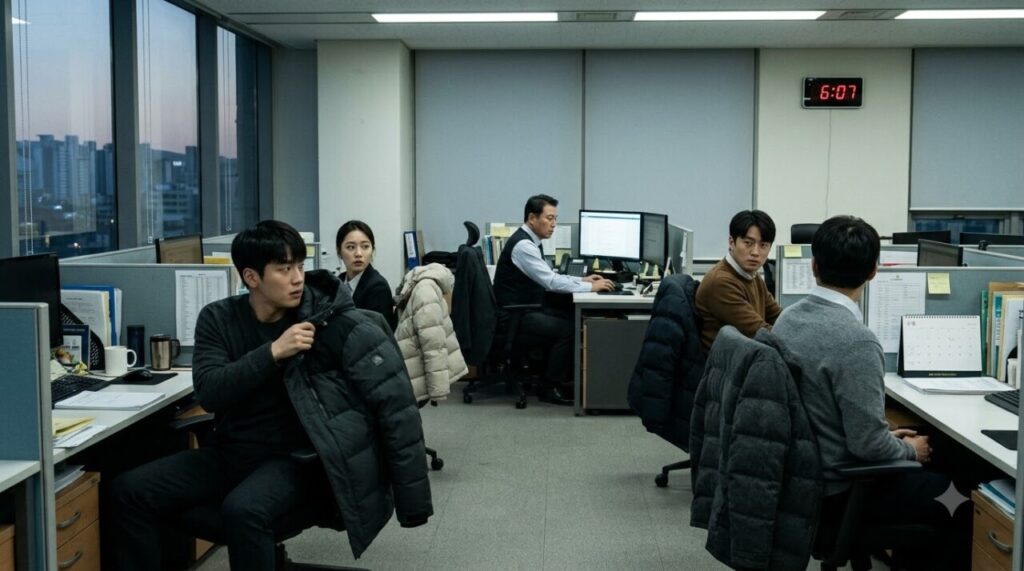
Scene 1: The after-work standoff. It’s 6:01 p.m. Work officially ended one minute ago. But your boss is still at their desk, typing very slowly, and nobody has moved. Nobody told you to stay, and nobody told you that you can go. So you do what Koreans call nunchi boda (눈치 보다), literally “to look at nunchi,” which means checking everyone’s reactions before you move. Is the boss packing up? Are the seniors reaching for their coats? The quick reader waits for the first sign. The clue-free one announces “Bye, everyone, I have dinner plans!” at 6:01 sharp.
Scene 2: “Let’s grab a meal sometime.” Bap han beon meokja (밥 한번 먹자) translates to “let’s eat together sometime.” You run into an old classmate, and as you part ways they say it with a big smile. Is it an invitation or a goodbye? In my experience it can be either, and the clues are small. Did they name a day? Did they pull out their phone? Or did they just wave and walk away? A real invitation usually comes with a date. If it didn’t, the nunchi-quick reply is a warm “Yes, let’s!” The clue-free reply is “Great! How’s Tuesday?” and then everyone gets very quiet.
(Nobody announces these tests. That’s the whole point.)
So why does English have no single word for it?
English has pieces of it. “Emotional intelligence” is the closest Western concept, but nunchi also depends on where you stand in status relative to the person you’re talking to. “Social intelligence” gets used too, but nunchi adds context recognition, micro-expression reading, and nonverbal communication.
English speakers do this all the time. We “read the room,” “take the hint,” and “read between the lines.” Even in the West, plenty of situations call for nunchi, whether or not you have a word for it. The difference is how it’s treated. English has a handful of phrases for specific moments. Korean has one word for a skill you’re expected to run all the time. It means constantly recalibrating your assumptions with every new word, gesture or expression. Parents teach it, it gets graded on speed (quick or slow), and it always includes who outranks whom.
Here’s one theory for why. Anthropologist Edward T. Hall introduced the high-context versus low-context idea in his 1976 book Beyond Culture. In low-context cultures like the US or Germany, meaning is packed into explicit words. Korea, Japan and China are usually given as high-context examples, where a lot goes unsaid. Hall treated this as a continuum, not a binary. If you can say “I’m upset” out loud, the skill of noticing it first doesn’t need a famous word of its own.
1. Hierarchy lives inside the language. Korean honorifics reflect age, social status, gender, closeness and context. Confucian values put heavy weight on age and status, and even a one-year gap can call for honorifics. Before you speak, you have to quietly work out who you’re talking to. That is nunchi.
2. The language often leaves things out. Korean often avoids the word “you” between strangers. A name, a title, or nothing at all stands in, and context fills in the rest. If the sentence doesn’t spell it out, the listener has to.
3. It’s taught like road safety. Korean parents teach nunchi alongside “look both ways” and “don’t hit your sister,” and “Why do you have no nunchi?!” is a classic scolding.
Korea’s cousin: Japan’s “reading the air”
Japan has a very similar idea. Kuuki wo yomu (空気を読む), “reading the air,” is a basic social skill in Japan. Misreading the air can sink business deals or damage relationships. Someone who can’t do it gets called KY (空気が読めない, kuuki ga yomenai). The name comes from the initials of the phrase, and it’s pronounced “kay-wai” when spoken.
What they share: both are high-context cultures with a built-in nickname for the clueless one. “Nunchi eopda” and “KY” are basically sisters.
Where they differ (a difference of emphasis, not a rule):
- What you “read.” Japan’s phrase points at the atmosphere, the shared air of the room. Nunchi is “eye-measure,” and by definition it includes your status relative to the person you’re interacting with. In Korea, the first question is often “who am I talking to?”
- How it’s framed. In Korea, nunchi gets sold as a skill with a speed rating (quick!). In Japan, the phrase is often heard as a verdict. Being told “kuuki wo yome!” is a very direct command, and it means you’ve seriously overstepped.
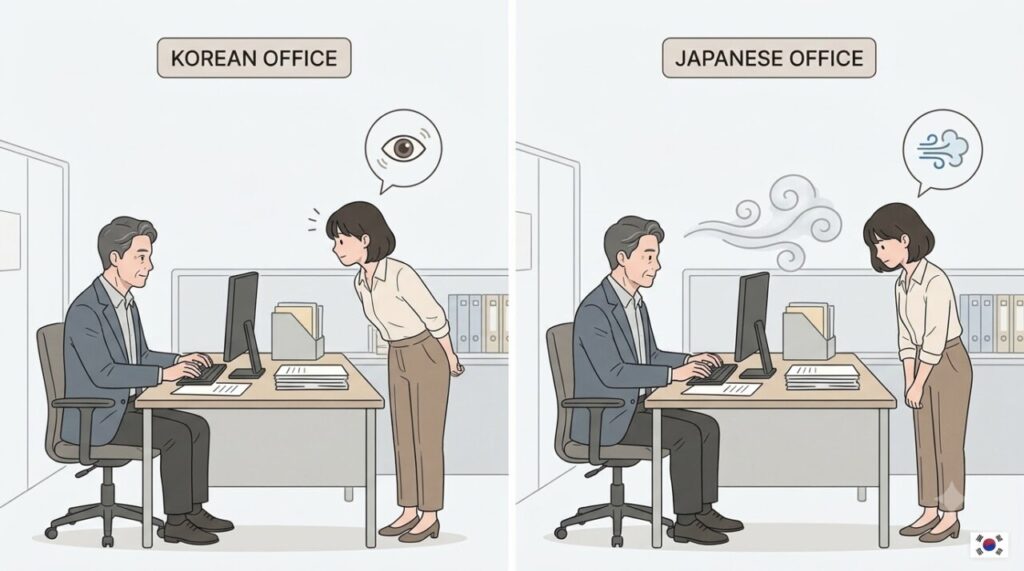
So: Korea says “level up your nunchi.” Japan says “please read the air before I have to say it.” Both are lovingly passive-aggressive.
Want to train your nunchi?
Stay quiet and listen carefully before you speak. Watch who talks, who stays quiet, and who’s quietly reaching for their coat at 6:01. Congratulations, you’ve just leveled up. And if you still can’t tell whether that “let’s eat sometime” was real, that’s okay. Nobody’s born with quick nunchi, and the friend you’re not sure about is probably still working it out too.
Sources
- Wikipedia, “Nunchi”: https://en.wikipedia.org/wiki/Nunchi
- World Economic Forum:
1. https://www.weforum.org/stories/2019/09/the-power-of-nunchi-the-korean-secret-to-happiness-and-success-an-extract/
2. https://weforum.org/agenda/2019/09/the-power-of-nunchi-the-korean-secret-to-happiness-and-success-an-extract - The Guardian : https://www.pressreader.com/usa/the-guardian-usa/20191112/281831465554585
- Wikipedia, “Korean honorifics”: https://en.wikipedia.org/wiki/Korean_honorifics
- University of Michigan LSA, “How ‘reading the air’ keeps Japan running”: https://prod.lsa.umich.edu/psych/news-events/all-news/faculty-news/how–reading-the-air–keeps-japan-running.html
- Japan Dev, “kuuki wo yomu”: https://japan-dev.com/blog/its-in-the-air-the-meaning-of-kuuki-wo-yomu%3Flang=j
- Wikipedia, “High- and low-context cultures” : https://bafybeiemxf5abjwjbikoz4mc3a3dla6ual3jsgpdr4cjr3oz3evfyavhwq.ipfs.4everland.io/wiki/High-_and_low-context_cultures.html
- Edward T. Hall, Beyond Culture (Anchor Books, 1976)