
You sit down at your first Korean BBQ, fresh off a K-drama binge, ready to look effortlessly cool. Then the server arrives with a pair of tongs in one hand and what looks like office-supply-meets-garden-shears in the other. She snips your pork belly into bite-sized pieces right over the fire. Snip, snip, snip.
Is this normal? Is this safe? Is this… fine dining?
Yes, yes, and honestly, yes. Let’s untangle the story of Korea’s most unexpected dinner utensil.
The Short Answer: It’s Just Really Practical
Scissors cut food held in the air or sitting right on the grill, so there’s no cutting board needed. Scissors solve the geometry problem of cutting food suspended in the air or directly over a hot grill, with no cutting board required. They also save you an extra plate on the table. Cutting directly on the grill saves time and makes shareable portions at the table.
At a busy restaurant, that adds up. Servers, often affectionately called “a-jum-ma(아줌마)” or “yi-mo(이모),” cut the meat into bite-size pieces with scissors and tongs, and that bit of human contact brings guests and the restaurant closer. Think of it as dinner and a tiny performance.
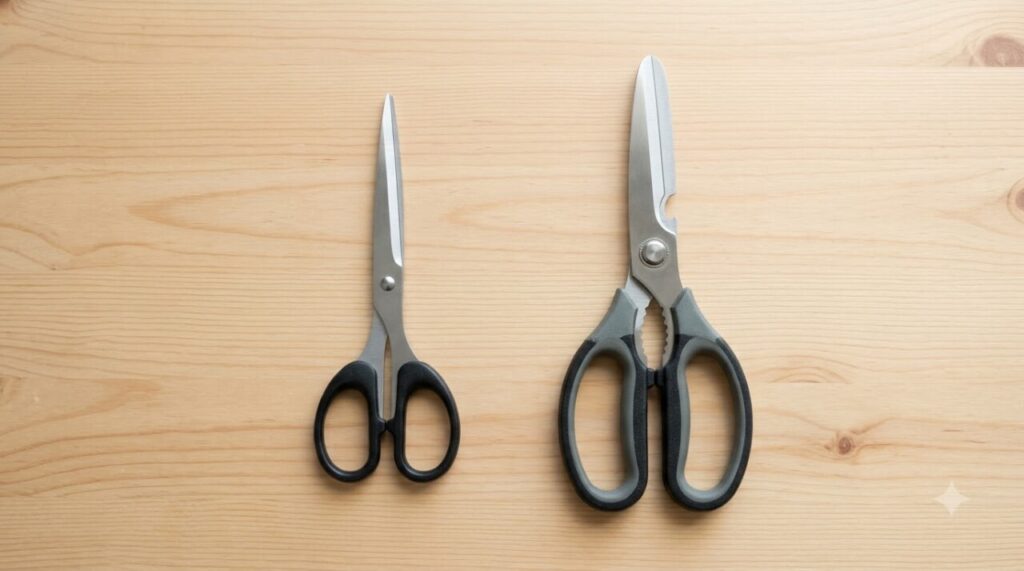
And no, these aren’t the scissors from your desk drawer. Food scissors have rounded tips and a bigger grip, designed for cutting tough meat with food contact in mind.
The Backstory: A Surprisingly Recent Habit
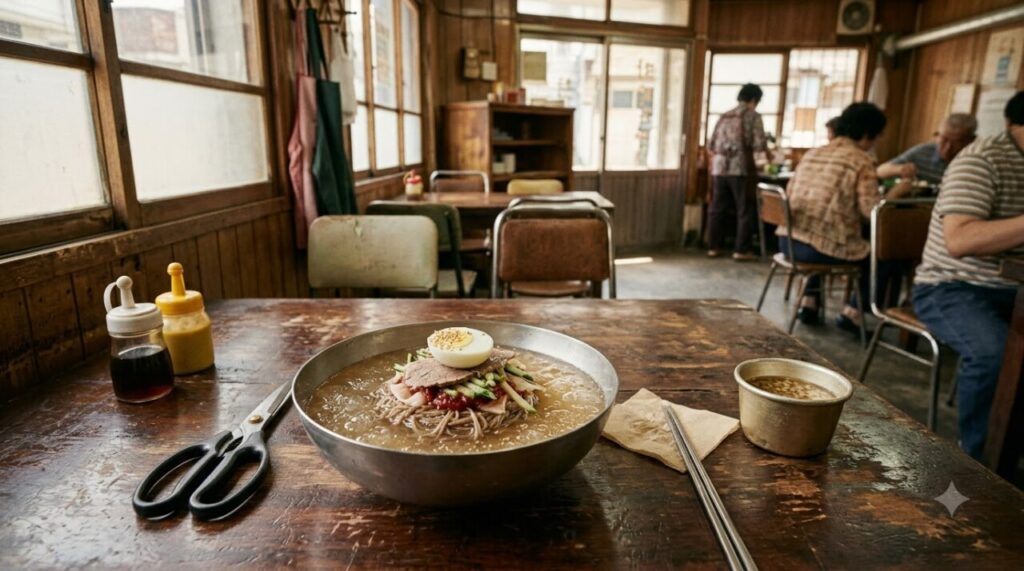
Here’s the plot twist: scissors on the table aren’t an ancient royal-court tradition. Using scissors at the dining table was originally not a traditional Korean custom, and is said to have started in the 1970s with cold buckwheat noodles (naeng-myeon/냉면). That noodle story is the most commonly repeated explanation, though I couldn’t find a single documented “inventor,” so take it as the best-known account rather than a proven origin.
Timing makes sense, too. Korean meat consumption was about 3.6 kg(127 oz) per person in 1961, rose to 11 kg(388 oz) in 1979, and reached 40 kg(1,410 oz) by 1997. As grilled meat went from a special treat to a regular night out, restaurants needed a fast way to portion it. Scissors were already around, and the habit spread.
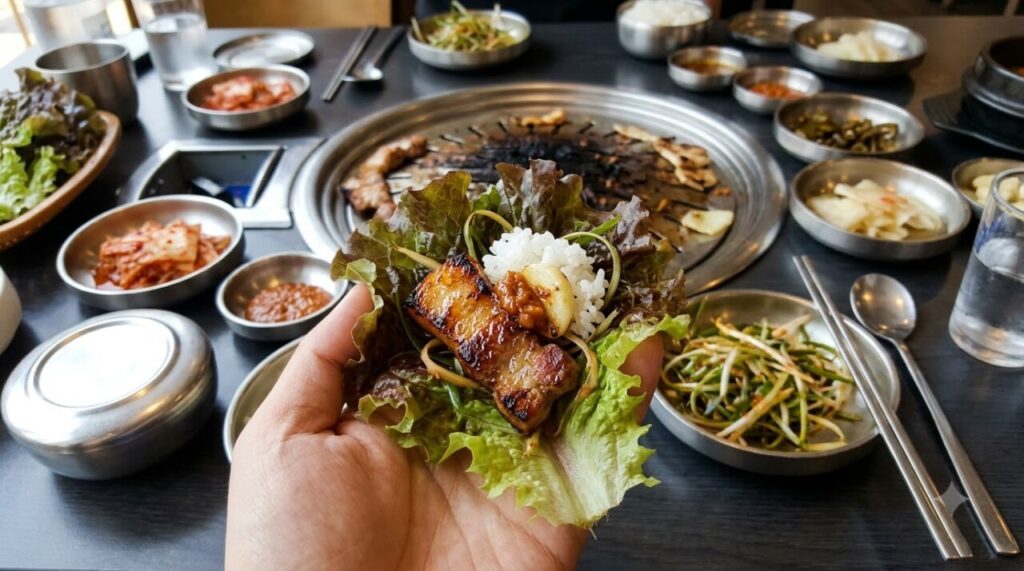
Another reason it stuck: Korean BBQ is built around the ssam(쌈), a single bite of meat wrapped with rice, vegetables, and sauce in a leaf. Koreans wrap the meat with rice and an assortment of vegetables and condiments inside a lettuce or perilla leaf, folding it into one generous mouthful. A bite-sized piece is the whole point, and scissors make it in two seconds.
One columnist also suggests there’s a business angle: he argued that diners want to eat quickly with whatever tools are available, and restaurant owners want a quicker cycle of patrons. That’s his opinion, not a proven fact, but it fits Korea’s famously fast-moving “palli-palli(빨리빨리)” (hurry-hurry) spirit.
Scissors Beyond the Grill
Once scissors proved themselves, they took over. Koreans cut noodles, seafood, and pancakes with them. Many Korean homes use scissors to portion whole-leaf kimchi straight into the serving dish, skipping the cutting board. Basically, if it’s on the table and too big, it’s getting snipped. (Yes, pizza too. Just ask Min.)
Your First K-BBQ Cheat Sheet
- Let the server cut. At many restaurants, staff do it for you. Sit back and enjoy the show.
- Doing it yourself? The classic move is tongs in one hand, scissors in the other, cutting right over the grill.
- Don’t be scared of the scissors. Remember: rounded tips, big grip, built for dinner.
Final Bite
Scissors at the table started as a practical shortcut, probably around the 1970s, and became part of how Korea eats. It’s fast, tidy, and surprisingly satisfying once you try it.
Sources
- https://www.koreatimes.co.kr/opinion/20150719/scissors-dancing-on-dining-table
- https://korea.stripes.com/food-drink/scissors-make-the-cut-in-korean-kitchens.html
- https://daebak.co/blogs/magazine/scissors-for-everything-food-related
- https://magazine.weverse.io/article/view/174?lang=en
- https://www.theglobeandmail.com/life/miga/article785409/
- https://morningcalm.koreanair.com/en/issues/may-june-2026-vol-50-no-03/samgyeopsal
- https://www.smithsonianmag.com/legacy_blog/the-history-of-chopsticks/
- https://sites.google.com/sheffield.ac.uk/chinese-chopsticks/history-of-chopsticks
- https://www.secret-retreats.com/blog/?p=12775
- https://www.magical-trip.com/media/yakiniku-guide-the-delicious-world-of-japanese-bbq/
- https://myannoyingopinions.com/2025/08/02/yakiniku-horumon-arai-ya-shibuya-tokyo-june-2025
- https://sunilsemail.substack.com/p/the-chopsticks-conundrum